
Card Game Manufacturing
Custom Game Card Printing: A Buyer’s Specification Guide
Table of Contents
- What Should Buyers Specify First?
- What Is Custom Game Card Printing?
- Key Specification Takeaways
- Materials for Custom Game Card Printing
- Game Card Sizes and Shapes
- Surface Finishes Compared
- Specifications by Game Card Application
- Artwork and Prepress Requirements
- Sampling and Bulk Production Process
- Quality Control for Card Decks
- Packaging and Worldwide Shipping
- Conclusion
A practical B2B guide to selecting game card stock, dimensions, surface finishes, packaging, samples, quality controls, and shipping arrangements.
What Should Buyers Specify First?
For a successful custom game card printing project, specify the card dimensions, card count per deck, material, thickness, finish, corner shape, packaging, order quantity, and destination before requesting a quotation. These choices determine handling performance, print appearance, box dimensions, production method, shipping weight, and cost.
There is no single best specification for every game. A frequently shuffled strategy deck needs different handling characteristics from cards placed on a board, collected in sleeves, or used only occasionally. Buyers should therefore begin with the way players will use the cards rather than selecting the heaviest stock or most decorative finish.
Specifications, MOQ, price, sampling method, and lead time depend on the project requirements. Supplying complete information allows a manufacturer to recommend compatible materials and identify potential production issues before sampling.
- Card format: finished width, height, corner radius, and shape.
- Deck structure: number of unique faces, common backs, and cards per deck.
- Performance: desired stiffness, flexibility, shuffle feel, and durability.
- Appearance: color expectations, coating, texture, and special effects.
- Delivery format: box type, inserts, wrapping, cartons, and shipping destination.
Buyers ready to compare manufacturing options can review YBJ Cards Printing’s custom card game printing service.
What Is Custom Game Card Printing?
Custom game card printing is the manufacture of printed card decks to a buyer’s own artwork, dimensions, card sequence, material, finish, and packaging specification. It can cover standalone card games, board game decks, expansion packs, reference cards, collectible sets, and educational game components.
Several technical terms are important:
- GSM
- Grams per square metre, a measurement of paper weight. GSM helps describe stock but does not independently determine thickness or stiffness.
- Caliper
- The physical thickness of a card or sheet, usually measured in millimetres or microns. Two stocks with the same GSM can have different calipers.
- Core
- An internal layer in some card stocks that contributes to opacity, stiffness, and handling.
- Lamination
- A thin film bonded to printed stock for surface protection or visual effect.
- Coating or varnish
- A liquid surface treatment applied and cured on the printed sheet. It is generally thinner than film lamination.
- Die cutting
- The process used to cut cards to their finished shape, including rounded corners or custom outlines.
These terms should be evaluated together. Choosing stock only by GSM can produce a deck that is thicker, softer, or less flexible than expected.
Key Specification Takeaways
- Select material according to shuffle frequency, stiffness, moisture exposure, and target positioning—not weight alone.
- Use a standard card size when sleeve compatibility, compact packaging, or tooling efficiency matters.
- Confirm whether a finish changes color, glare, texture, writability, or recyclability expectations.
- Test a physical sample when thickness, shuffle feel, box fit, or special finishing is commercially important.
- Approve both card and packaging specifications together because deck thickness controls the internal box dimensions.
- Define measurable inspection criteria, including card count, cutting tolerance, color reference, finish coverage, collation, and packing method.
Materials for Custom Game Card Printing
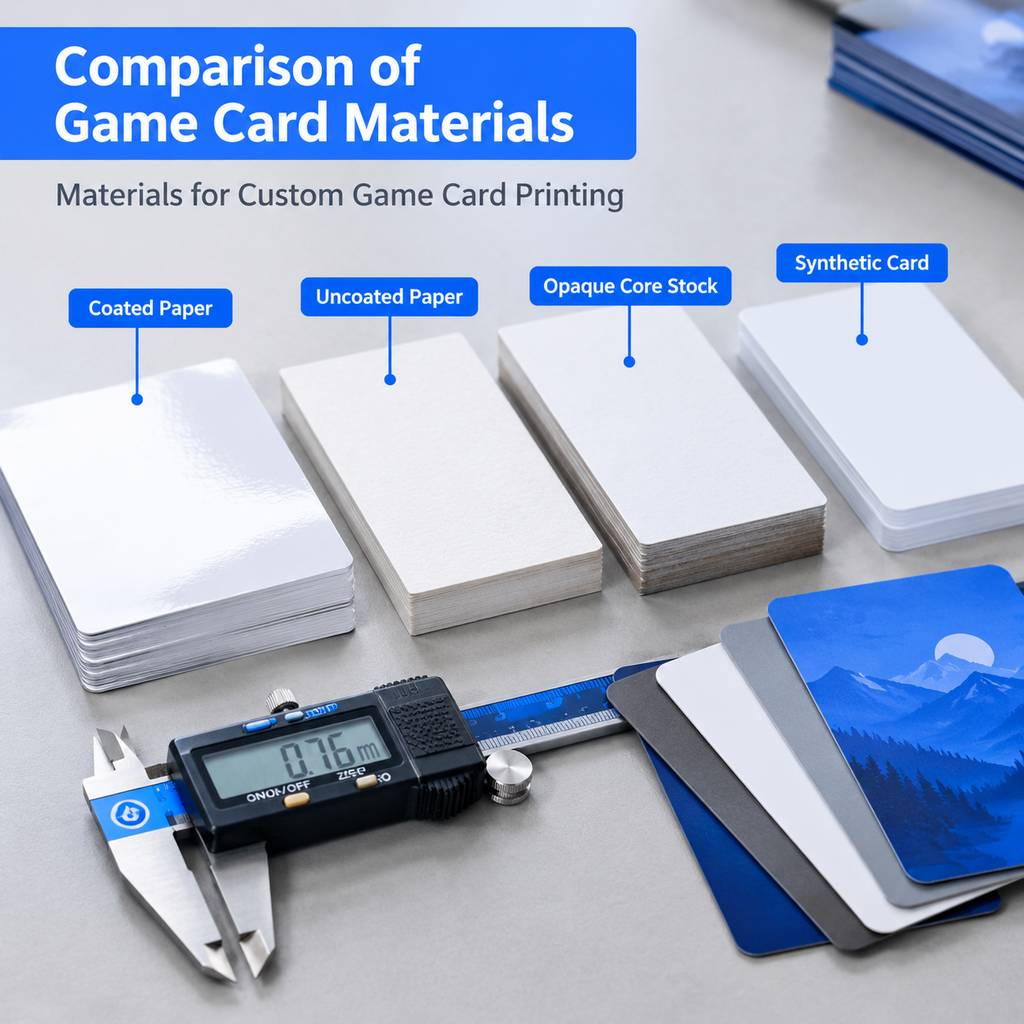
The right game card stock balances print quality, opacity, stiffness, flexibility, durability, deck thickness, and budget. Paper-based card stock is common for retail card games because it provides familiar handling and supports a wide range of printing and finishing processes. Synthetic materials can be considered when water resistance or frequent cleaning is a priority.
| Material option | Typical characteristics | Suitable applications | Trade-offs to evaluate |
|---|---|---|---|
| Coated paper card stock | Smooth printable surface, economical production, broad finish compatibility | Board game decks, family games, promotional games | Durability depends on stock construction and surface treatment |
| Black-core card stock | Opaque internal core, familiar snap and handling when correctly specified | Card games where reverse-side show-through should be minimized | Higher weight does not automatically mean better handling; sample the exact stock |
| Blue-core or grey-core stock | Internal core provides opacity and structural support | General game cards and decks with moderate handling requirements | Color, stiffness, and availability vary by mill and specification |
| Uncoated paper stock | Natural tactile surface and improved writability | Legacy-style games, score cards, cards requiring player notes | Can mark more easily and reproduce colors differently from coated stock |
| Synthetic or plastic material | Moisture resistance and high durability, depending on the substrate | Travel, hospitality, outdoor, or frequently cleaned games | Different shuffle feel, printing process, cost, and disposal considerations |
Ask the supplier to state both the nominal material weight and approximate finished caliper. For a large deck, a small change in each card’s thickness can significantly alter box depth and shipment weight. Grain direction, coating, core construction, and lamination also influence stiffness and shuffle performance.
Game Card Sizes and Shapes
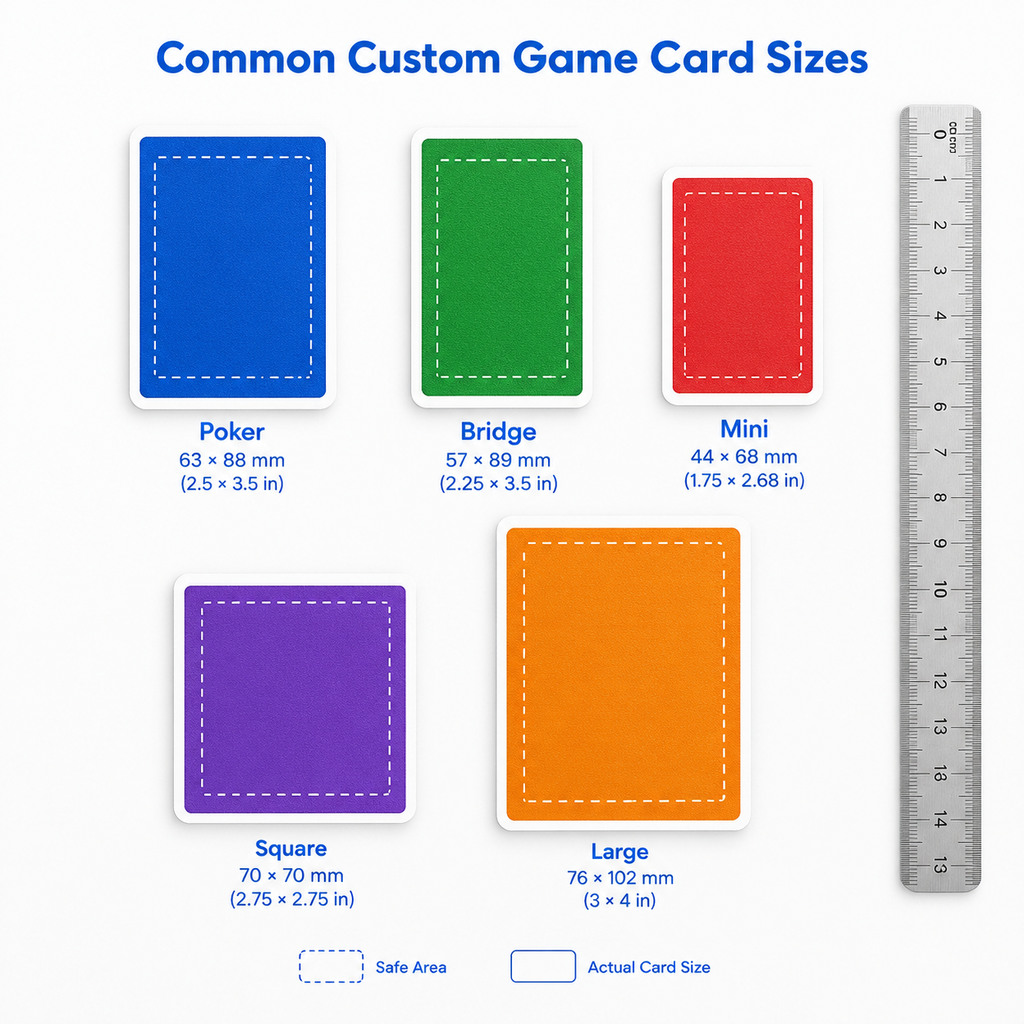
Card size should suit information density, player handling, table space, packaging, and any sleeves or accessories included in the game. Common formats can be useful starting points, but dimensions must always be confirmed in the purchase specification rather than assumed from a format name.
| Format example | Common nominal dimensions | Practical use |
|---|---|---|
| Poker format | Approximately 63 × 88 mm | General card games, strategy decks, and widely available sleeves |
| Bridge format | Approximately 57 × 89 mm | Larger hands of cards or narrower packaging |
| Mini format | Project-specific; often around 44 × 68 mm | Tokens, compact decks, status cards, or travel games |
| Square cards | Project-specific, such as 70 × 70 mm | Visual matching, children’s games, and board layouts |
| Large-format cards | Defined according to content and use | Reference cards, storytelling, party games, or accessibility needs |
These dimensions are examples, not mandatory standards. The final dieline must state finished size, bleed, safe area, corner radius, and cutting tolerance. A custom shape can create distinction, but it may require dedicated tooling, increase material waste, complicate automated collation, and limit sleeve options.
Corner radius also affects handling. Rounded corners resist catching and feel familiar during shuffling, while a very large radius reduces usable artwork space near the corners. If the game will use standard sleeves, test both the card and sleeve before locking the box dimensions.
Surface Finishes Compared
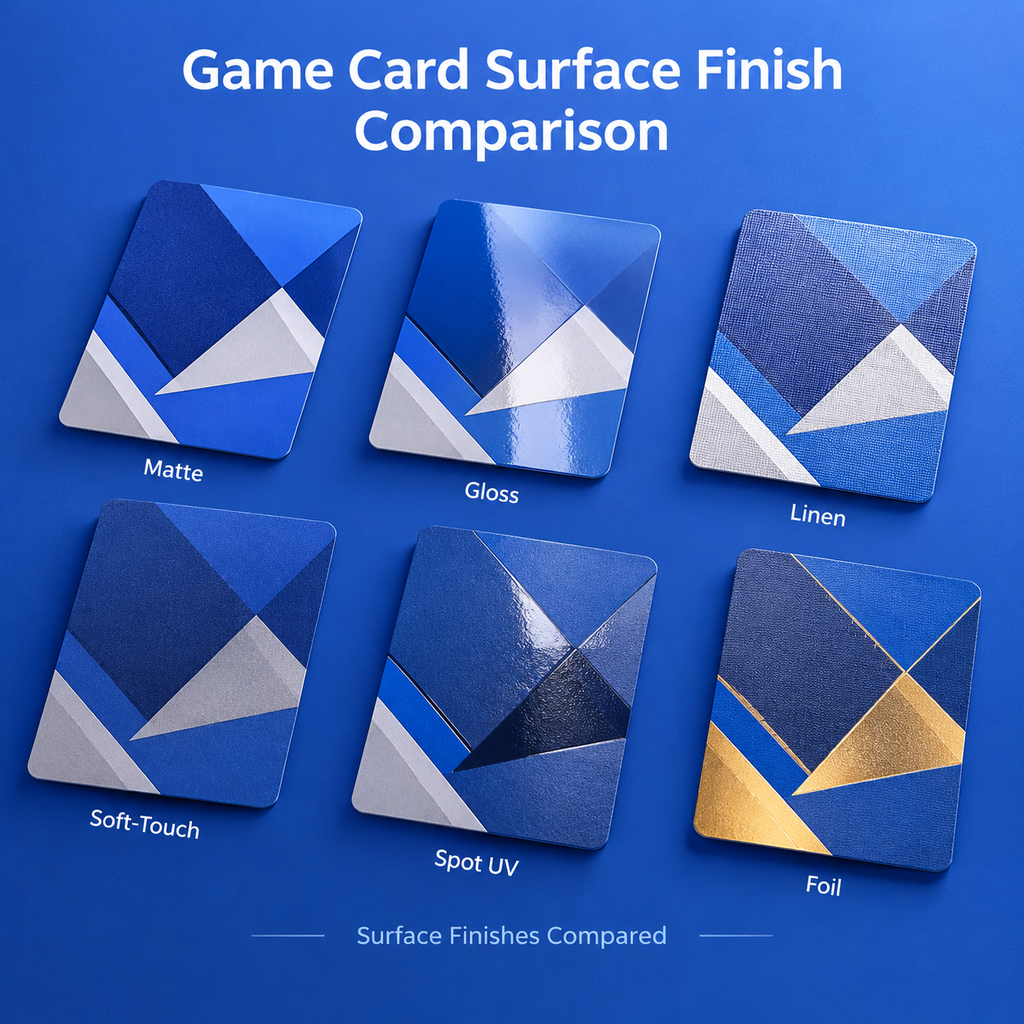
A game card finish changes more than appearance. It can influence friction, glare, scratch resistance, color perception, writability, fingerprint visibility, and how easily cards slide during play. Finish compatibility depends on the stock, ink system, artwork, and any later processes.
| Finish | Appearance and handling | Advantages | Points to confirm |
|---|---|---|---|
| Gloss coating or varnish | Reflective surface with strong color impact | Easy-to-clean feel and bright presentation | Glare, fingerprints, and sliding friction under play conditions |
| Matte coating or lamination | Low-glare, restrained appearance | Readable under varied lighting and suitable for premium artwork | Dark areas may show rubbing or surface marks differently |
| Linen or embossed texture | Patterned tactile surface | Distinct handling and reduced flat-surface contact | Fine details and small text should be tested against the texture |
| Soft-touch lamination | Velvety tactile effect | Premium presentation | Scuff behavior, fingerprint visibility, and shuffle friction |
| Spot UV | Gloss highlight on selected areas | Creates contrast on logos or artwork details | Registration tolerance and suitability for frequently flexed cards |
| Metallic foil | Reflective stamped detail | Useful for limited editions, titles, or rarity indicators | Minimum line widths, stamping tolerance, cost, and artwork setup |
Decorative processes should be used selectively. Full-bleed foil, heavy spot treatments, or effects crossing cut lines require technical review. If players must write on the cards, request an uncoated or writable area and test the intended pen or marker. A finish should be approved on a representative physical sample whenever tactile performance is important.
Specifications by Game Card Application
The following product table provides practical starting points rather than fixed production standards. Final recommendations should be based on gameplay tests, artwork, budget, order quantity, and retail positioning.
| Card application | Material priority | Size approach | Finish priority | Packaging consideration |
|---|---|---|---|---|
| Frequently shuffled strategy deck | Opacity, snap, controlled flexibility, edge durability | Hand-friendly standard format where suitable | Consistent glide with manageable glare | Allow accurate deck clearance and optional sleeve space |
| Board game component deck | Consistency with tokens, boards, and overall product level | Fit the board layout and table footprint | Readability and color consistency | Coordinate with insert wells and master game box |
| Children’s matching game | Stiffness, cleanable surface, rounded corners | Larger format for handling and image recognition | Durable, low-maintenance surface | Easy opening and organized storage |
| Collector or limited-edition deck | Stable premium stock and opacity | Standard or distinctive format based on audience | Selective foil, texture, or spot effects | Rigid or magnetic presentation may be considered |
| Write-on game cards | Writable face surface | Enough space for player input | Uncoated or specially designated writing area | Consider pens, instructions, and replaceable components |
Educational or training games may share requirements with flash cards, especially where readability and repeated classroom handling matter. Buyers can compare those needs with this guide to custom flash card materials and production.
Artwork and Prepress Requirements
Production-ready files reduce delays and prevent important content from being cut, shifted, or printed unexpectedly. Obtain the manufacturer’s current dieline before finalizing card faces, backs, box artwork, or inserts.
- Use the supplied template. Build artwork to the confirmed finished dimensions and corner geometry.
- Extend backgrounds into the bleed. Bleed is artwork extending beyond the trim line to prevent unintended white edges after cutting.
- Keep critical content inside the safe area. Text, icons, borders, and game values should not sit too close to the cut.
- Prepare print color correctly. Use the requested CMYK profile and identify any spot colors or metallic effects separately.
- Check images and fonts. Use adequate effective resolution and embed or outline fonts according to prepress instructions.
- Define the card sequence. Provide a clear card list showing quantities, face-to-back pairing, and any duplicate cards.
- Review borders carefully. Narrow symmetrical borders make normal cutting variation more visible.
For detailed file preparation, review the card artwork requirements for bleed, color, and files. If cards include digital links or serialized content, additional data and scan testing may be needed; see the guide to printing cards with QR codes and barcodes.
Sampling and Bulk Production Process
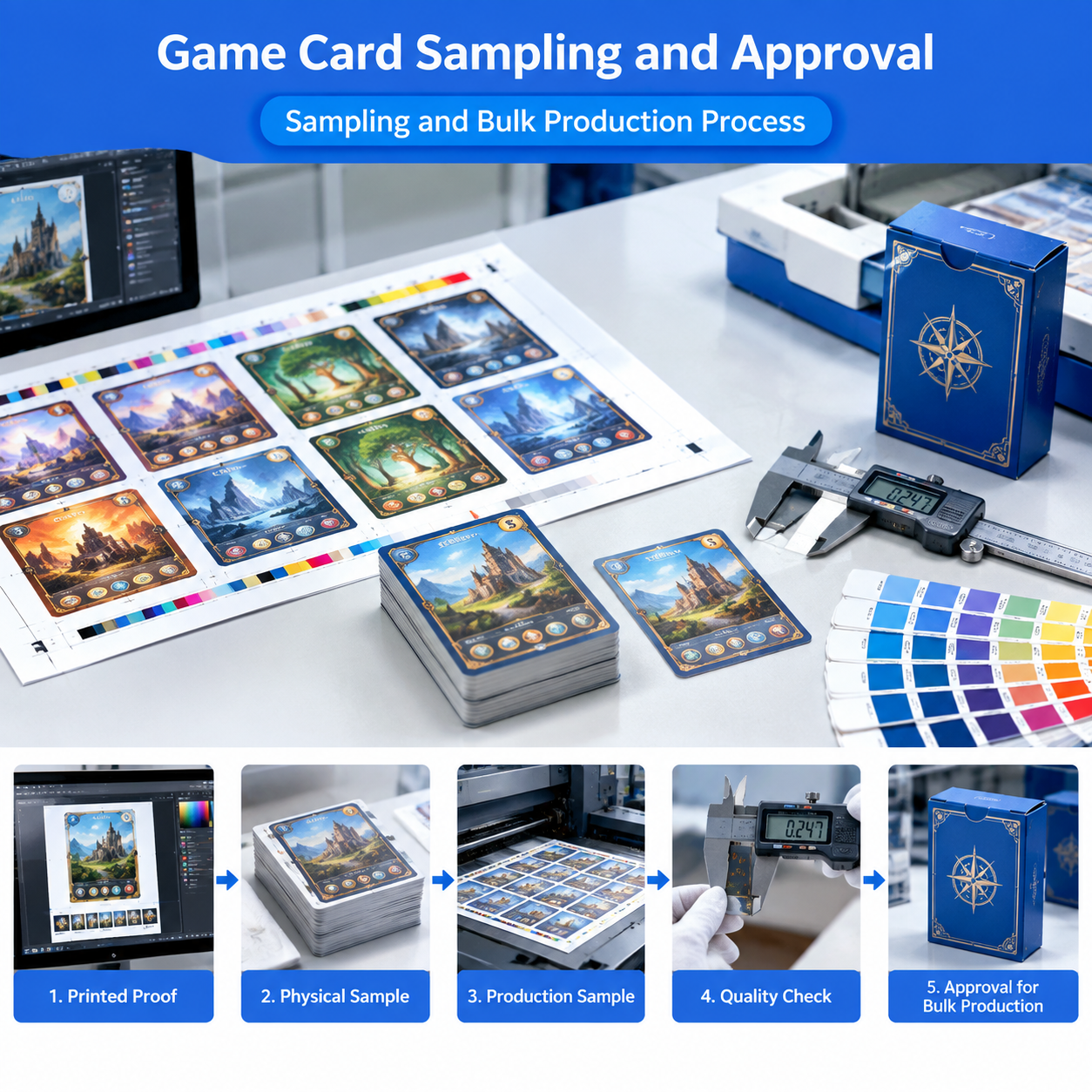
Sampling should match the decision the buyer needs to make. A digital proof is useful for checking layout, text, sequence, and general color placement, but it may not reproduce the exact bulk stock, coating, cutting, or special finish. A physical prototype is more useful for testing size, handling, deck thickness, and box construction. A production-representative sample may be appropriate when exact materials and finishing are commercially critical, subject to process and quantity limitations.
- Project review: Confirm card count, dimensions, stock, thickness, finish, packaging, quantity, destination, and compliance requirements where applicable.
- Artwork review: Check dielines, bleed, safe areas, color setup, card sequence, fonts, and special-finish layers.
- Sampling: Select the proof or sample type based on what needs approval.
- Sample evaluation: Inspect content, color reference, hand feel, shuffle performance, finish, corner cutting, deck height, and box fit.
- Approval: Record approved files and specifications before bulk production.
- Bulk manufacturing: Print, surface-finish, cut, collate, assemble, wrap, and pack according to the order.
- Inspection and dispatch: Complete agreed quality checks and prepare export packing and shipping documents.
MOQ depends on dimensions, material availability, print process, finish, packaging, and the level of customization. Price and lead time also depend on the approved specification and production schedule. Buyers should request that quotations clearly separate cards, packaging, sampling, tooling where applicable, and freight.
Quality Control for Card Decks
Card deck quality control must cover individual cards and the complete assembled product. A visually acceptable print run can still fail if cards are missing, duplicated, incorrectly oriented, or packed in the wrong box.
YBJ Cards Printing applies seven-stage quality control across project review, production, finishing, assembly, and packing. The exact inspection plan should be agreed according to the game’s risk level and specification. Useful control points include:
- Incoming material identity, appearance, and specified thickness.
- Prepress file version, card count, and face-to-back orientation.
- Print registration, color consistency, text clarity, and contamination.
- Finish coverage, adhesion, texture, foil position, or spot-effect registration.
- Cut size, corner shape, edge condition, and card alignment.
- Collation, duplicate or missing card checks, deck count, and box fit.
- Wrapping, barcode placement, carton quantity, carton marks, and export packing.
Color should be approved against an agreed reference under consistent viewing conditions. Screen displays are not reliable physical color standards. For critical brand colors, discuss proofing and measurable color expectations before production rather than after delivery.
Packaging and Worldwide Shipping
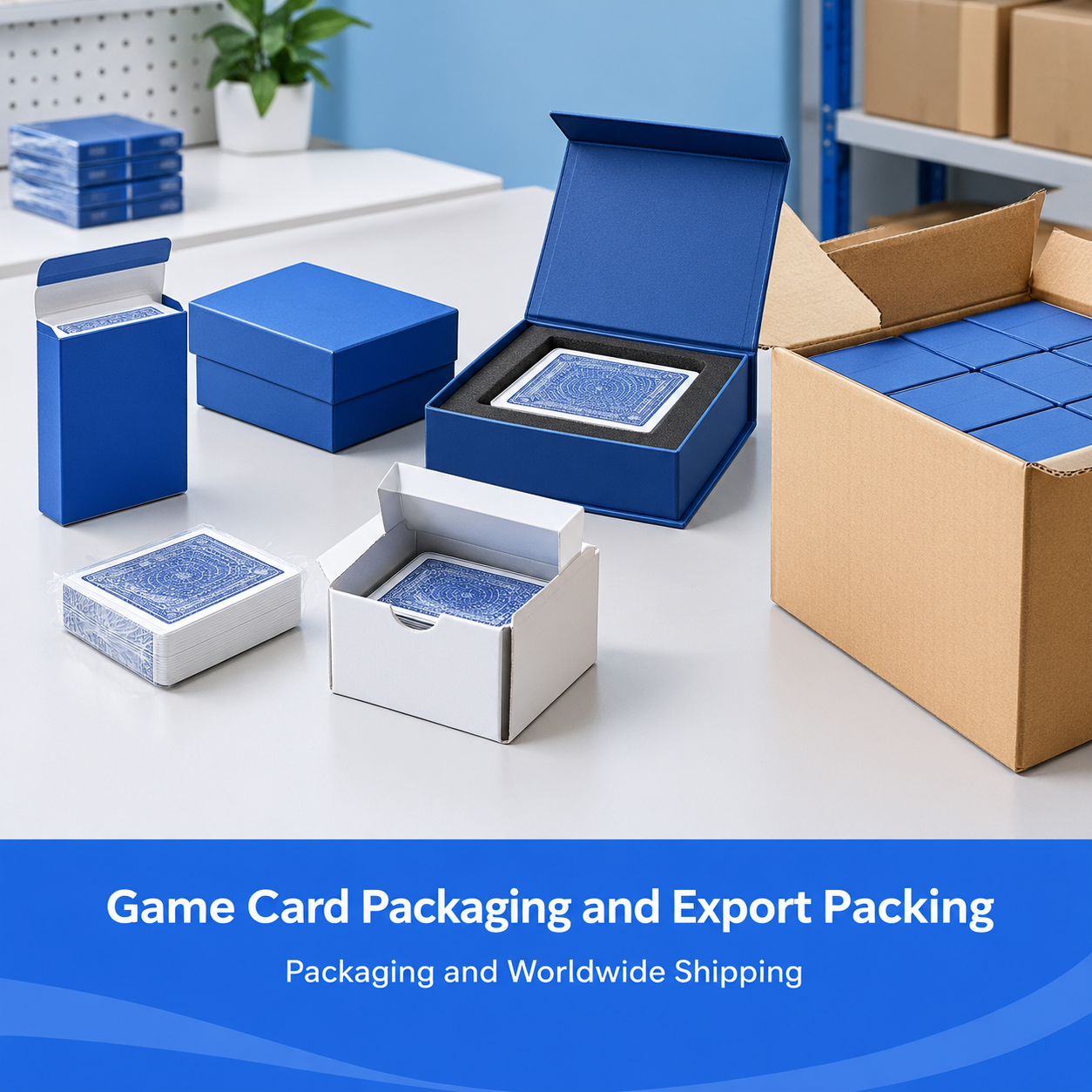
Packaging should be engineered after the card stock, finish, card count, and finished deck height are known. A tuck box is compact and efficient for many retail decks. Rigid boxes offer greater structural protection and presentation value, while magnetic boxes can suit premium sets but add weight, volume, and assembly complexity.
Other options include paper bands, shrink wrapping where suitable, card trays, booklets, inserts, dividers, master game boxes, and export cartons. The internal box size needs enough clearance for loading and removal without allowing excessive movement. If players are expected to store sleeved cards in the original package, that requirement must be specified before structural design.
Compare tuck boxes, rigid boxes, and magnetic card packaging before approving the final structure.
For export shipping, consider:
- Individual deck protection and any retail wrapping requirements.
- Inner carton and master carton quantities.
- Carton strength, product weight, and void control.
- Pallet requirements, carton marks, and destination handling.
- Air, courier, sea, rail, or combined transport options where available.
- Freight terms, customs documentation, duties, taxes, and cargo insurance responsibilities.
Shipping cost and transit planning depend on packed dimensions, gross weight, destination, transport mode, and trade terms. Delivery estimates should be confirmed for the specific order rather than assumed from a general schedule.
Conclusion
Effective custom game card printing starts with gameplay requirements and converts them into measurable manufacturing specifications. Material weight, caliper, core, size, finish, corner geometry, card count, and packaging must work as one system. Sampling then verifies handling and box fit, while documented quality checks help control color, cutting, collation, assembly, and export packing.
Before comparing quotations, give each supplier the same specification and clarify what is included. Specifications, MOQ, price, and lead time depend on project requirements, so a complete brief produces a more useful recommendation than a request based only on deck quantity.
FAQ
What is the best material for custom game cards?
There is no universal best material. Coated paper card stock is suitable for many retail games, while core stock can improve opacity and handling. Uncoated stock supports writability, and synthetic material can be considered for moisture resistance. Select the material according to shuffle frequency, required stiffness, deck thickness, finish, budget, and packaging.
What size should a custom game card deck use?
Poker format, approximately 63 × 88 mm, is a common starting point, but it is not mandatory. The correct size depends on information density, hand size, table space, sleeve compatibility, board layout, and packaging. Confirm the exact finished dimensions, corner radius, bleed, and safe area with the manufacturer.
Should game cards use matte, gloss, or linen finishing?
Matte finishes reduce glare, gloss can increase visual contrast, and linen texture changes tactile feel and surface contact. The best choice depends on artwork, lighting, shuffle behavior, desired positioning, and budget. Test a physical sample if surface feel or friction is important.
What is the MOQ for custom game card printing?
MOQ depends on the card size, material, printing method, finish, packaging structure, and customization level. A standard card deck with straightforward packaging may have different requirements from a custom-shaped, foil-finished collector set. Submit the complete specification and quantity tiers for an accurate assessment.
How long does sampling and bulk production take?
Lead time depends on artwork readiness, sample type, material availability, finishes, packaging, quantity, approval speed, and production scheduling. Shipping time is separate and depends on destination and transport mode. Ask for a project-specific schedule covering artwork review, sampling, approval, production, inspection, and dispatch.
Ready to Start Your Custom Card Project?
“Send us your card type, size, material, quantity, finish, and packaging requirements. Our factory team will recommend suitable production and sampling options and prepare a tailored quote.”
Keep Reading
Related Articles
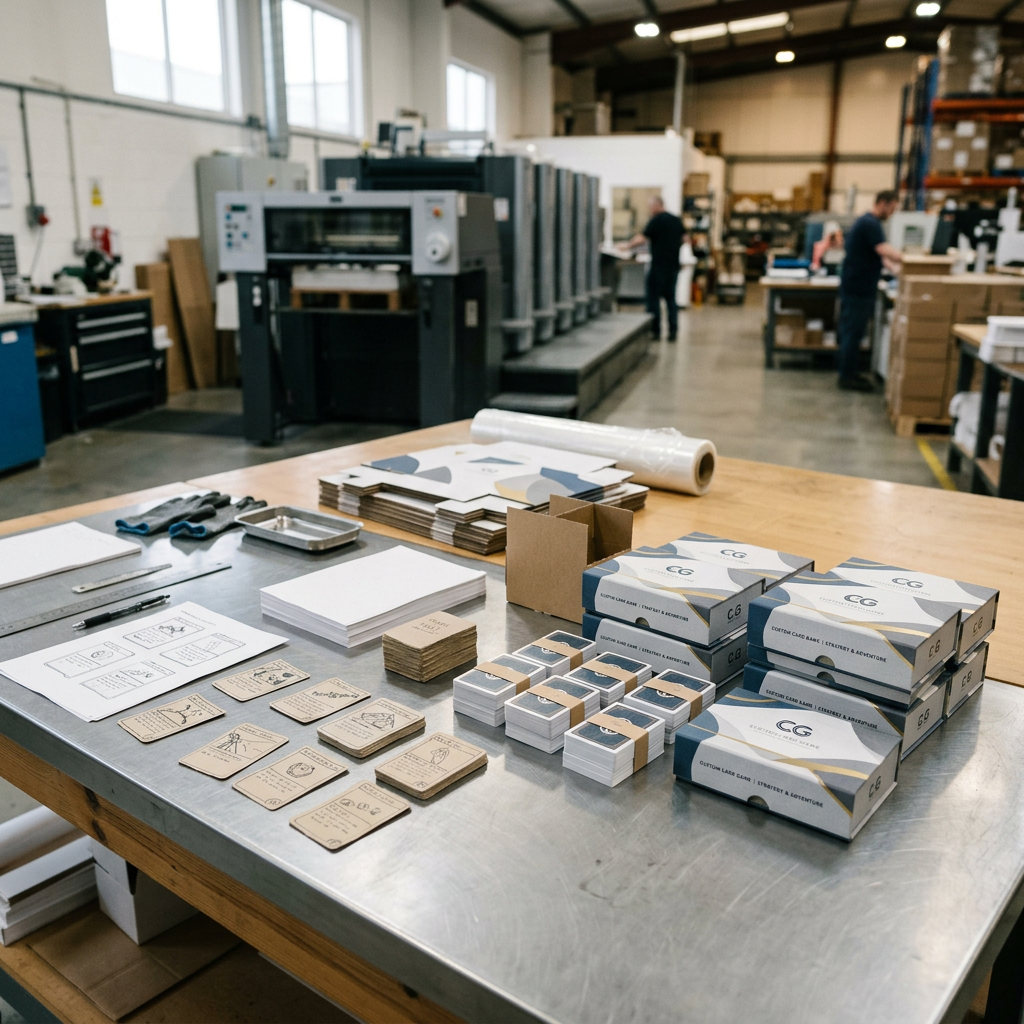
How to Manufacture a Card Game: From Prototype to Bulk Order
Learn how to manufacture a card game by moving through concept development, prototype testing, technical specifications, sampling, bulk production, quality control, packaging, and international shipping.
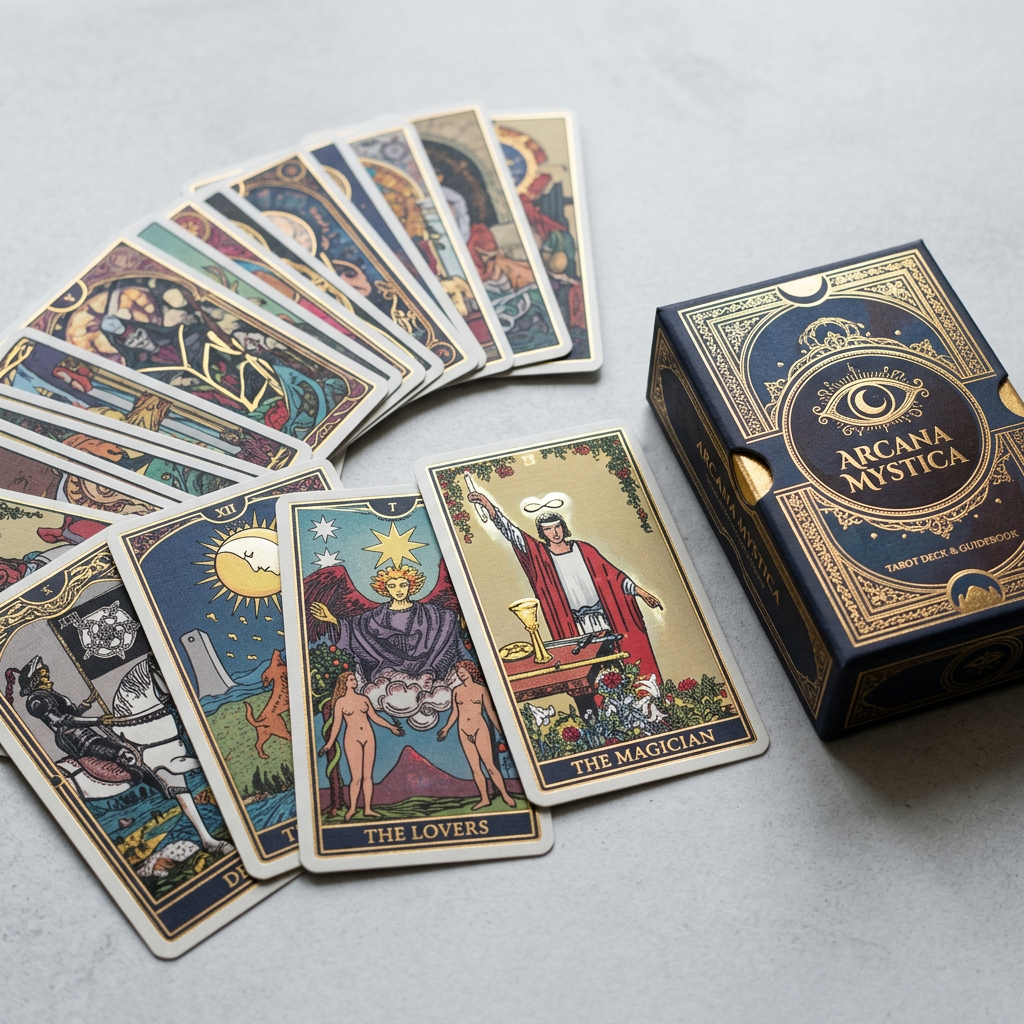
Custom Tarot Card Printing: Deck Specifications, Finishes, and Packaging
Custom tarot card printing requires more than artwork preparation. Buyers must coordinate deck size, card count, stock, finishes, packaging, sampling, quality control, and export shipping before approving bulk production. This guide explains the main decisions for publishers, game brands, retailers, spiritual product companies, and independent creators.
Custom Playing Card Printing: Materials, Finishes, and Packaging Guide
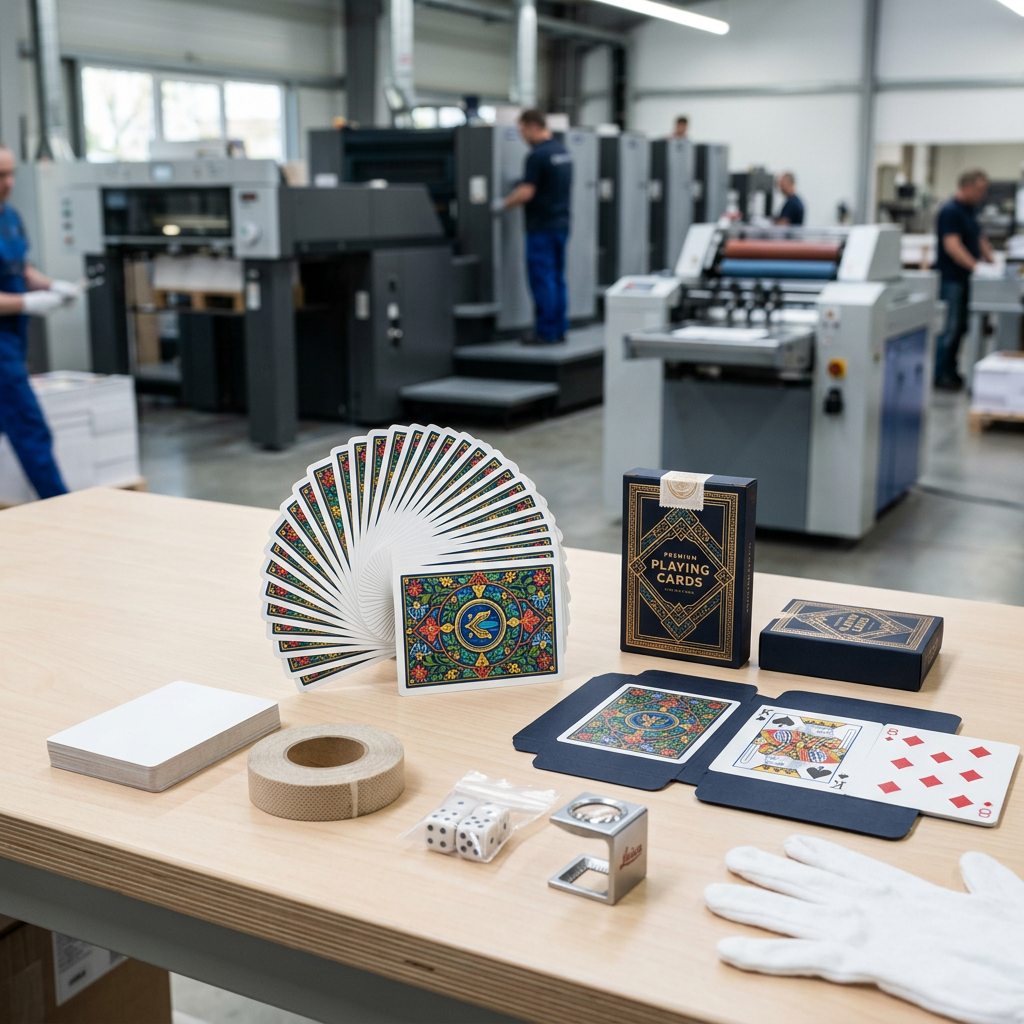
Custom playing card printing requires coordinated decisions about card stock, surface finishes, print quality, packaging, and shipment protection. This guide explains the main options for B2B buyers planning branded decks, promotional cards, educational products, game launches, and retail-ready playing card sets.
Fast Quote Support
Ready to Start Your Custom Card Project?
Send us your product type, size, material, quantity, and packaging requirements. Our team will reply within 24 hours with production suggestions, sampling options, and a competitive quote. No setup fees.