
Custom Card Printing Guides
How to Print Custom Cards with QR Codes and Barcodes in a Deck
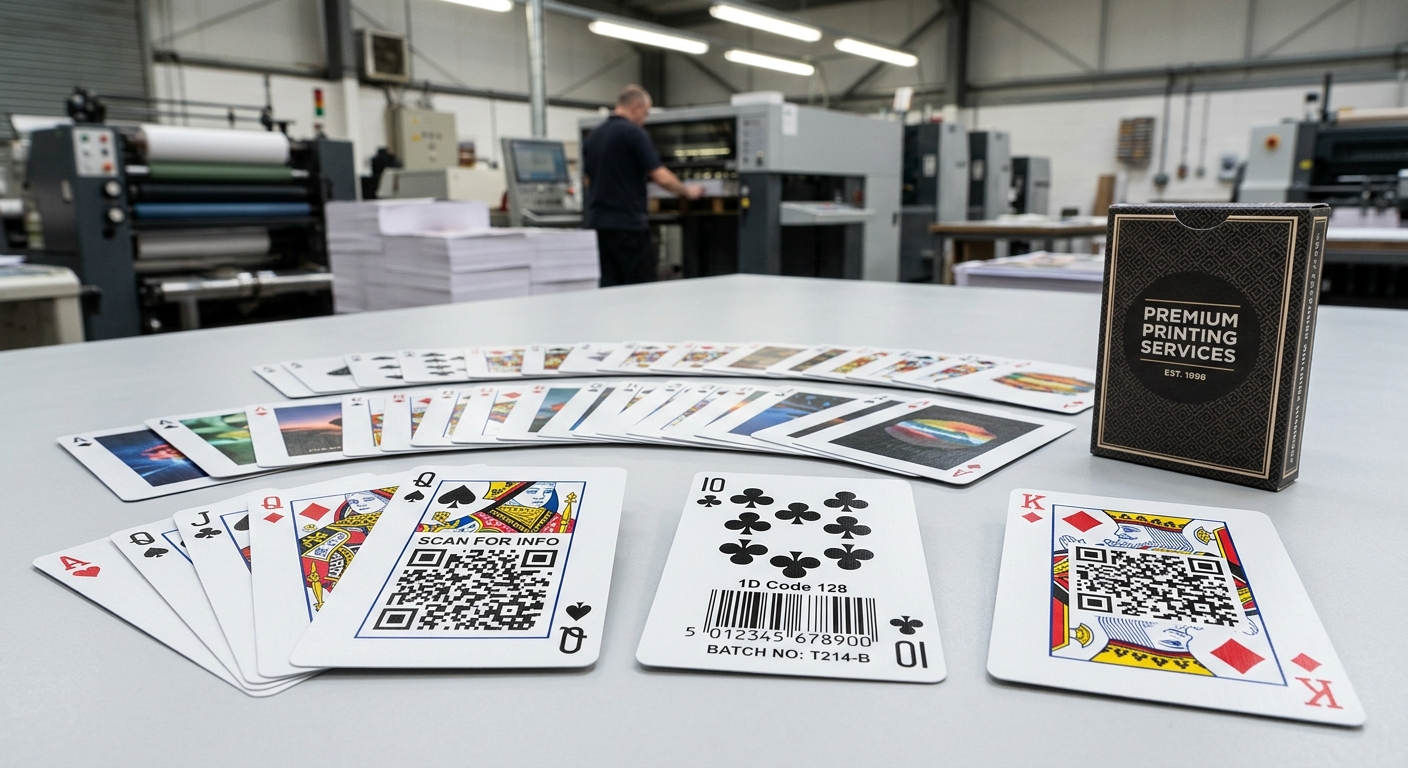
Table of Contents
- Can QR Codes and Barcodes Be Printed on Every Card?
- QR Codes, Barcodes, and Variable Data Defined
- Choose Static or Unique Codes
- Prepare the Code Database
- Artwork Requirements for Custom Cards with QR Codes
- Select Card Materials and Finishes
- Printing and Production Process
- Sampling and Scan Testing
- Quality Control for Coded Card Decks
- Collation and Packaging
- MOQ, Lead Time, Pricing, and Shipping
- Plan Custom Cards with QR Codes as a Complete System
Printing scannable codes on a custom card deck requires coordination between code generation, database management, artwork preparation, print production, finishing, and scan testing. This practical guide explains how B2B buyers can prepare reliable QR codes and barcodes for static or variable-data card decks.
Can QR Codes and Barcodes Be Printed on Every Card?
Yes. A manufacturer can print the same QR code or barcode on every card, assign a different code to each card, or combine a shared campaign code with unique serial information. The correct method depends on what the deck must do after scanning.
For reliable production, buyers should define the code type, encoded data, card size, material, finish, quantity, collation sequence, packaging, and verification method before bulk printing. Unique codes require a controlled database and variable data printing, while repeated codes can usually be included directly in the fixed artwork.
The main production risk is not whether a code can be printed. It is whether every printed code remains readable after resizing, color conversion, coating, cutting, packing, and distribution. Successful QR code card printing therefore combines suitable artwork with physical samples, representative scanner tests, and traceable quality control.
Applications include educational decks, promotions, game components, loyalty programs, authentication workflows, instructions, digital content access, and product registration. For campaign-specific format ideas, see this guide to custom promotional card printing.
QR Codes, Barcodes, and Variable Data Defined
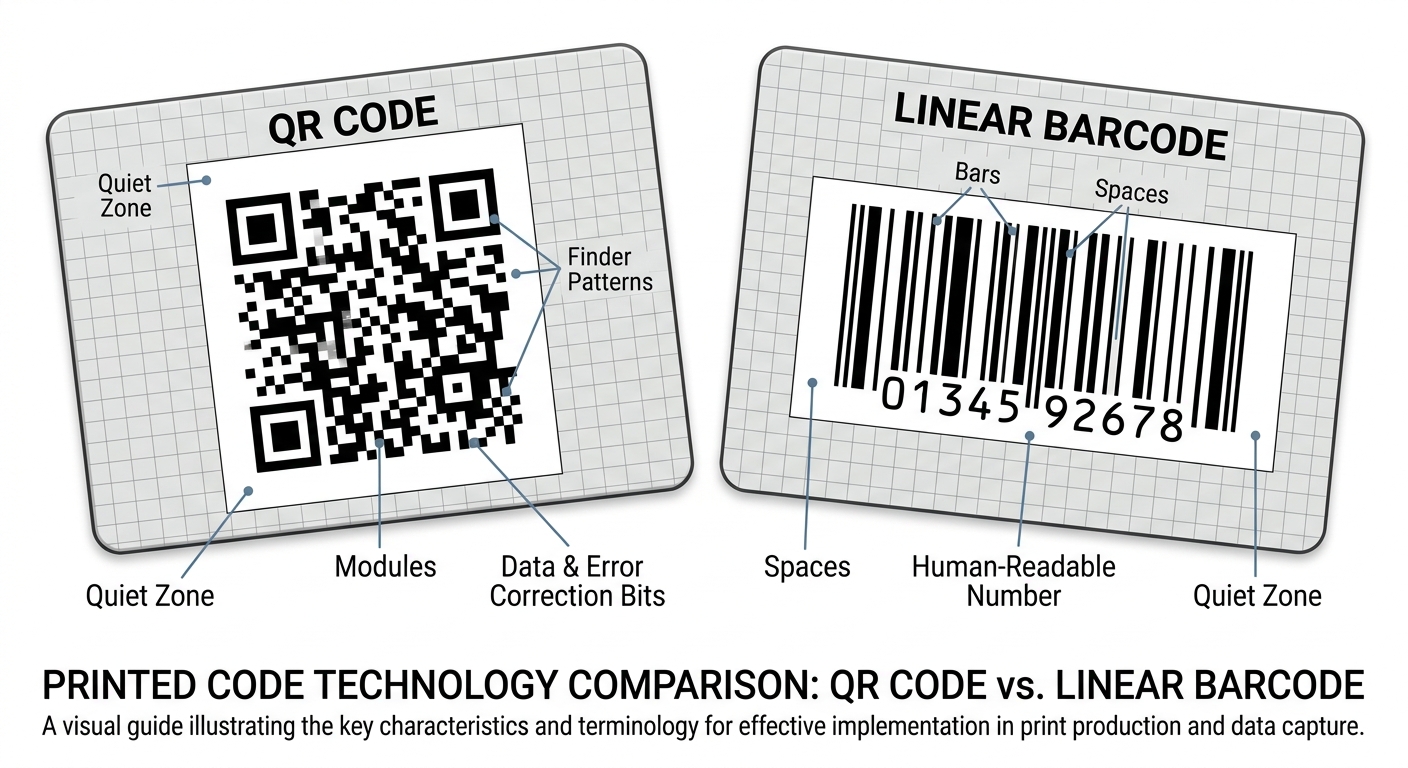
A QR code is a two-dimensional symbol made from square modules. It can encode a URL, identifier, text, contact information, or other data and is commonly read by smartphones or imaging scanners.
A linear barcode stores information in parallel bars and spaces. Common formats include Code 128 for alphanumeric internal identifiers and EAN or UPC symbols for retail applications. Retail barcode selection and number allocation should follow the requirements of the destination market and trading partners.
Variable data printing, or VDP, changes selected content from one printed card to the next. A VDP project can change a QR code, barcode, serial number, short URL, name, image, or several fields simultaneously. Fixed elements such as logos and instructions remain constant.
The quiet zone is the empty margin around a code. It separates the symbol from nearby graphics. Module size refers to the size of the smallest QR square or barcode element. Both must remain large and clear enough for the intended reader. QR error correction adds redundancy so that a code may remain readable despite limited damage, but it does not justify poor print contrast or an obstructed symbol.
Choose Static or Unique Codes
A static-code deck repeats one destination or identifier. It is appropriate when every card opens the same manual, campaign page, video, registration form, or rules page. Preparation is relatively simple because the code can be placed in the master artwork.
A variable-code deck gives every card—or every deck—a different identity. It may be used for individual lessons, game actions, serialized promotions, controlled downloads, or item tracking. The manufacturer must merge an approved database with the card template and preserve the required sequence during printing and packing.
Before choosing, answer these questions:
- Does each card lead to the same destination or different content?
- Must a code be unique per card, per deck, per carton, or per production batch?
- Can a code be used repeatedly, or should the backend limit redemption?
- Does card order matter inside each deck?
- Must a human-readable number appear below or beside the code?
- Who controls redirects and maintains destination URLs after distribution?
A printed QR code does not itself create secure authentication or single-use redemption. Those functions depend on the buyer’s database, website, application, or validation platform. Dynamic links can provide destination flexibility, but their long-term availability depends on the service managing the redirect.
Prepare the Code Database
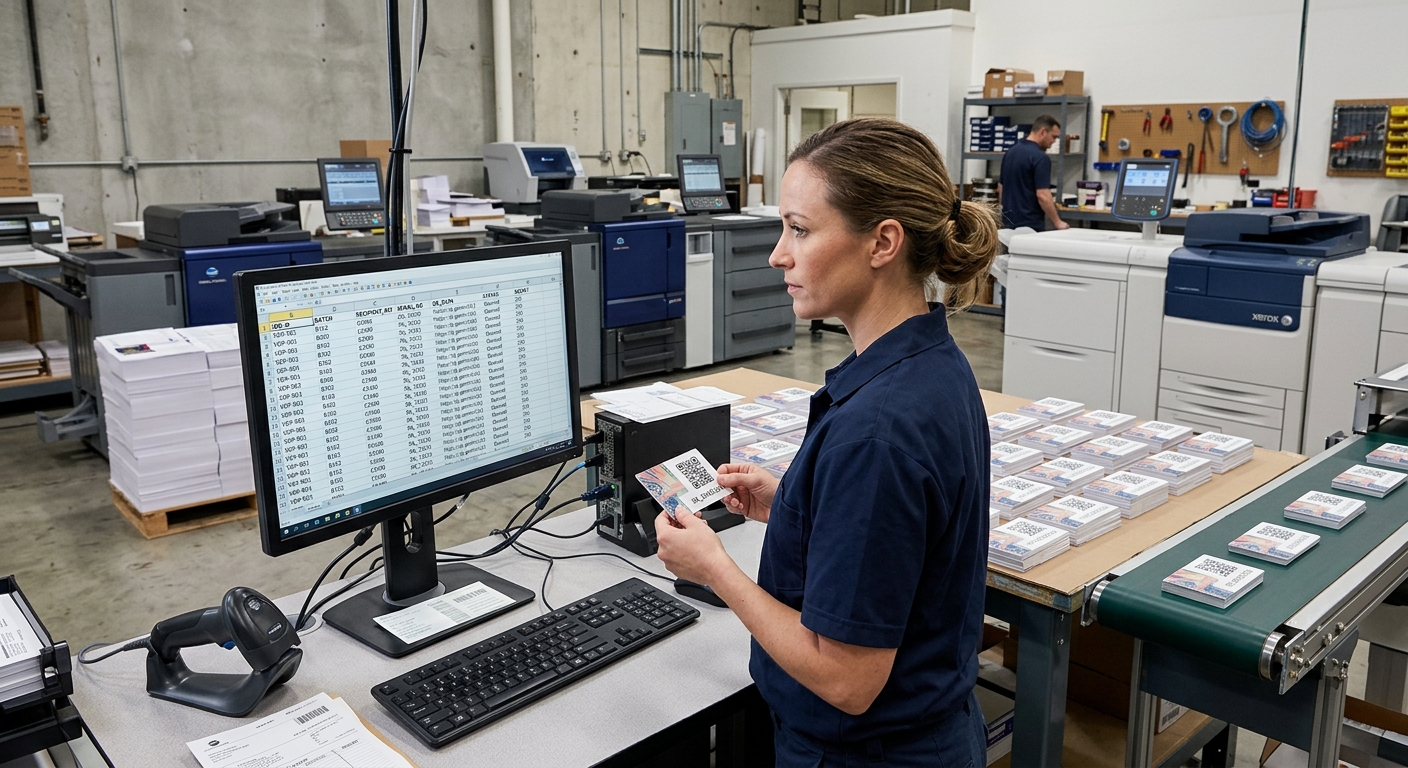
Variable data should be supplied as a structured spreadsheet or delimited data file. Each row normally represents one card record, while columns hold fields such as deck ID, card position, URL, QR payload, barcode value, visible serial number, language, or image filename.
Use a unique record ID that never changes during revisions. Avoid merged cells, unexplained color coding, hidden formulas, duplicate identifiers, and shortened values that remove leading zeros. If a barcode value must contain a fixed number of digits, store it as text so spreadsheet software does not alter it.
A practical handoff package includes:
- The final data file with clearly labeled columns
- A field map showing where each column appears in the artwork
- The expected number of cards, decks, and unique records
- Rules for card order and deck grouping
- Approved code symbology and data format
- Several manually verified sample records
- A written policy for unused, duplicate, or rejected codes
The buyer should validate that all URLs and identifiers are correct before data approval. A printer can check whether symbols are rendered and scannable, but cannot determine whether every destination contains the intended business content without an agreed validation procedure.
Artwork Requirements for Custom Cards with QR Codes
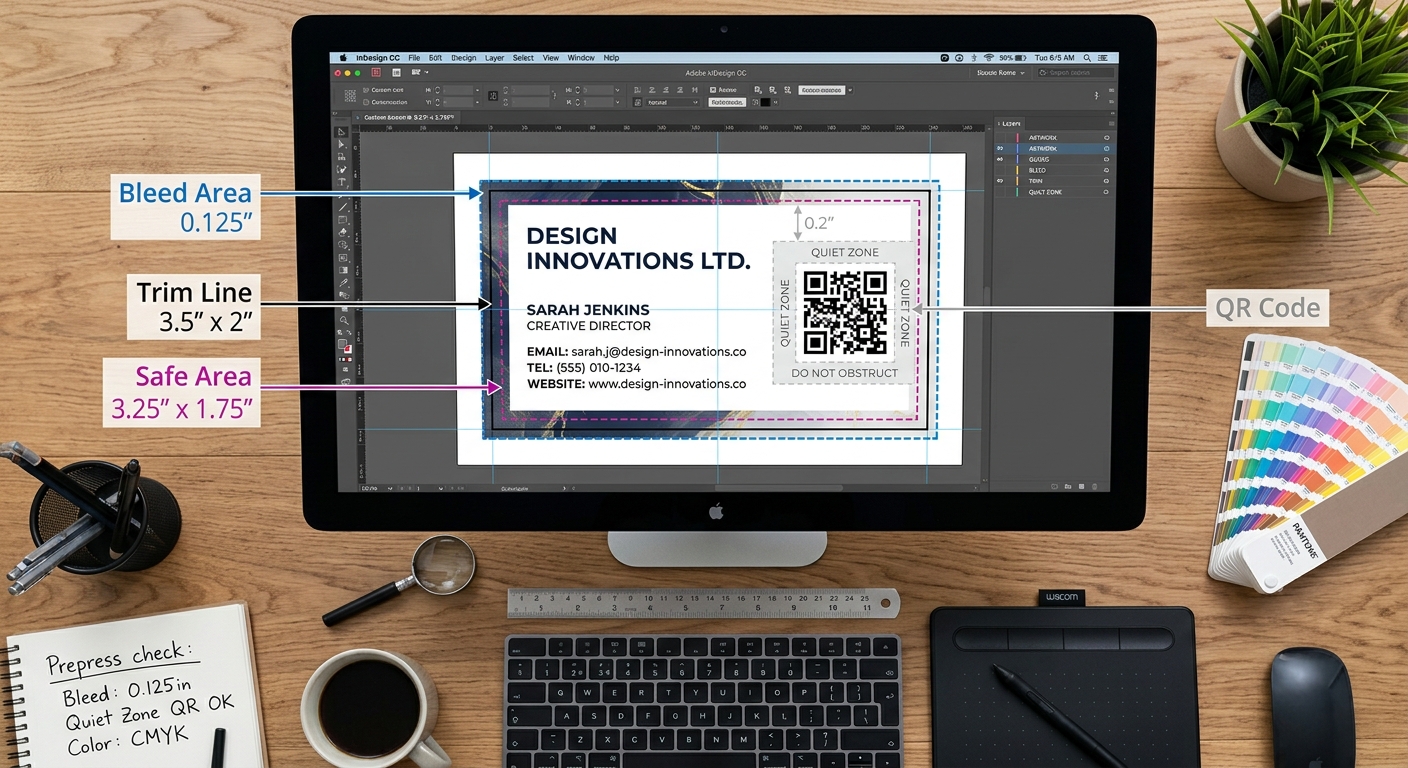
Artwork for custom cards with QR codes should reserve a clean, high-contrast area for each symbol. Keep codes away from trim lines, rounded corners, punched holes, signatures, textured backgrounds, and critical illustrations. The exact safe distance and minimum code size depend on the card dimensions, printing method, substrate, code density, and target scanner.
Black symbols on a white or very light background generally provide the most dependable contrast. Reversed, metallic, transparent, low-contrast, or multicolor codes require additional testing. Do not stretch a generated symbol or compress it unevenly. Avoid placing essential QR modules under foil, embossing, debossing, spot UV, holographic effects, or other finishes that can change reflectivity or surface shape.
Prepare the card template with the manufacturer’s bleed and safe-area requirements. Fixed artwork can normally be supplied as a print-ready PDF, while variable fields should be identified separately. Fonts may need to be embedded or outlined, and linked images should have adequate effective resolution.
Ask for a merged-data proof showing representative records, including the longest values and densest codes. Review card fronts and backs together so that the code-to-card relationship cannot be accidentally reversed.
Select Card Materials and Finishes
Paper card stock is common for boxed decks because it supports full-color graphics and a familiar card feel. The appropriate thickness, core, stiffness, surface treatment, and opacity depend on the deck’s card count, handling frequency, box dimensions, and desired shuffle characteristics.
PVC and other plastic card constructions can suit frequently handled identification, loyalty, access, or reference cards. Their print process, thickness options, finish behavior, and packing method differ from paper decks. Buyers evaluating this route can review the practical considerations in custom PVC card printing for membership and loyalty programs.
Matte or gloss surface treatments can protect printed cards, but reflectivity affects scanning under certain lighting. Heavy texture can reduce the edge definition of small code elements. Foil, metallic ink, glitter, and spot gloss may create glare or insufficient contrast if applied over the code area.
Choose the material and finish before finalizing minimum code dimensions. A code that works on an office proof may behave differently on coated paper or plastic. Physical testing should use the intended production material and finish whenever code performance is critical.
Printing and Production Process
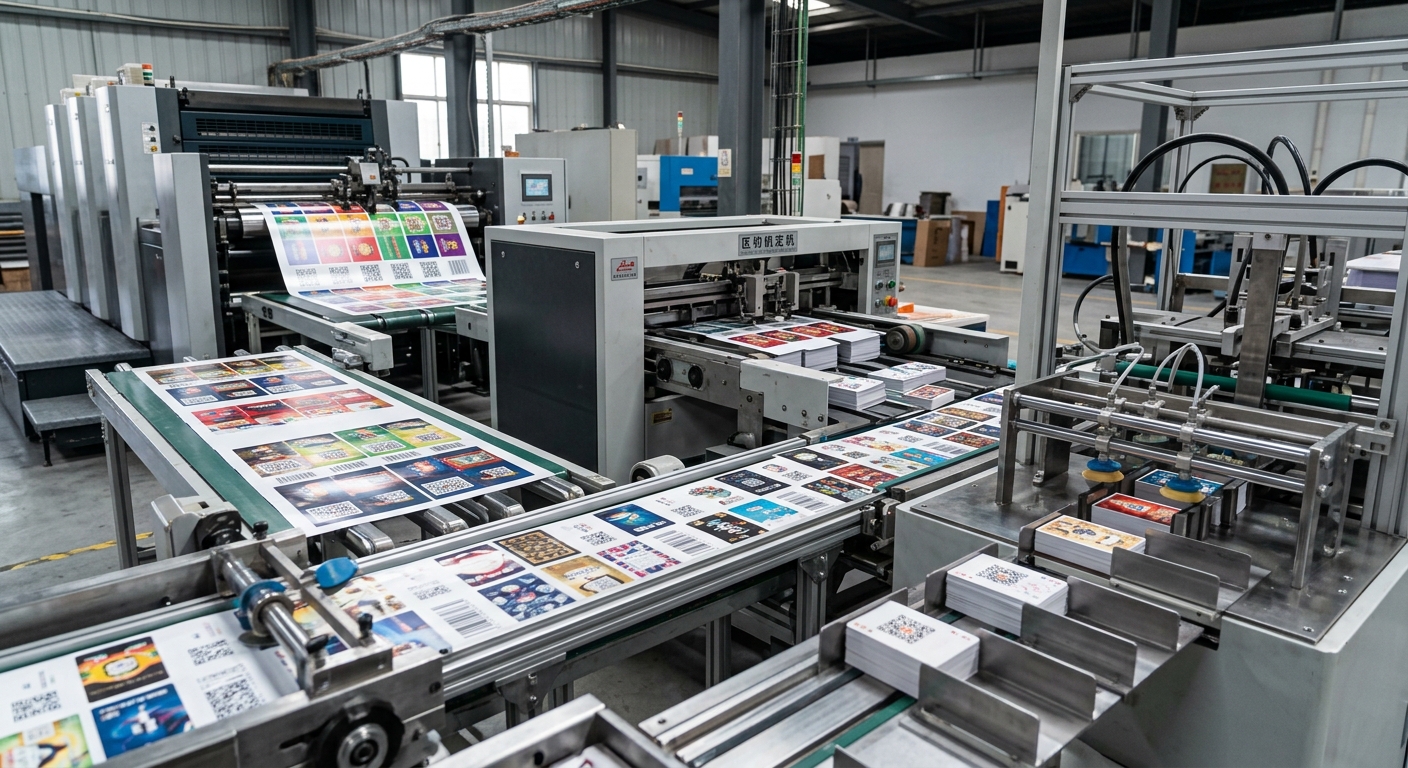
A controlled production workflow helps prevent data and collation errors. The exact equipment and sequence vary according to quantity, material, customization, and finishing, but a typical project follows these steps:
- Specification review: Confirm card size, count, material, code type, uniqueness rules, finishes, deck order, packaging, quantity, and shipping destination.
- Artwork preflight: Check dimensions, bleed, safe areas, color setup, image quality, fonts, code placement, and finishing layers.
- Data validation: Compare record counts, identify duplicate or missing values, and confirm variable-field mapping.
- Proof generation: Produce representative merged records rather than reviewing only an empty template.
- Sampling: Make a digital, production-grade, or other agreed sample appropriate to the project.
- Bulk printing: Print fixed graphics and variable elements using the approved production route.
- Finishing and cutting: Apply approved surface treatments, cut cards, and round corners where specified.
- Collation and packing: Assemble each deck in the required sequence and place it in the selected packaging.
- Inspection and export packing: Perform agreed checks and pack cartons for the planned transport method.
No production stage should begin from an unapproved database revision. File names, revision numbers, and approval records should clearly identify the released artwork and data.
Sampling and Scan Testing
A PDF proof is useful for checking layout, content, record mapping, and sequence, but it cannot reproduce the reflectivity, texture, dot gain, cutting variation, or coating behavior of a finished card. When scanning is a core function, request a physical sample made as closely as practical to the planned material and finish.
Testing should reflect actual use. Scan representative codes with the expected device types, operating systems, applications, distances, angles, and lighting conditions. Include the densest QR payload, the smallest symbol, the longest barcode, cards near anticipated production tolerances, and samples after finishing.
Agree on what constitutes a pass. Possible criteria include successful decoding, correct destination, agreement between encoded and human-readable values, acceptable response time from the buyer’s system, and correct placement within the specified area. Network or website performance should be evaluated separately from printed-symbol readability.
A sample confirms an agreed configuration; it does not automatically validate every variable record. For unique-code projects, combine physical sample testing with automated data checks and in-process scan verification.
Quality Control for Coded Card Decks

Quality control should address both conventional print quality and code integrity. At YBJ Cards Printing, a project can move through a seven-stage quality-control workflow covering material and file checks, production monitoring, finishing, collation, packing, and final shipment preparation as applicable to the approved specification.
Checks for coded decks may include:
- Card dimensions, corner shape, color, registration, and surface condition
- Code position, contrast, edge clarity, quiet zone, and visible damage
- Scan tests at agreed intervals or according to an approved inspection plan
- Comparison of encoded values with printed serial numbers
- Duplicate, missing, or malformed record checks
- Card count and sequence within selected decks
- Box labeling, carton identification, and batch traceability
Not every project requires the same inspection method. Scanning every card provides different coverage from statistical sampling but also affects production design, handling, data reporting, cost, and lead time. Buyers should specify whether they need sampled verification, full-code verification, scan-result files, or another documented procedure before quotation.
Collation and Packaging
Code uniqueness makes collation especially important. Define whether cards must follow numerical order, a fixed gameplay sequence, random order, language groups, or a parent-child relationship between cards and packaging. If a box carries its own code, state whether that code must match the enclosed deck ID.
Common packaging formats include tuck boxes, rigid boxes, magnetic cases, paper bands, shrink wrapping, and grouped cartons. The best choice depends on deck thickness, retail presentation, protection, sustainability priorities, fulfillment method, and budget. This overview of custom card packaging options explains the practical differences between tuck boxes, rigid boxes, and magnetic cases.
Packaging graphics should not expose usable promotional or access codes unless that is intentional. Tamper-evident or concealed-code requirements need to be discussed as separate functional specifications rather than assumed from ordinary wrapping.
For export shipments, carton size and weight should balance protection with handling efficiency. Inner protection, moisture-resistant wrapping where appropriate, carton labels, pallet requirements, and shipment marks should be confirmed before packing. Barcode labels on cartons must be managed separately from the consumer-facing codes printed on cards.
MOQ, Lead Time, Pricing, and Shipping
Specifications, MOQ, price, and lead time depend on project requirements. Important cost factors include card size, deck count, material, number of designs, static or variable data, code-verification level, print process, finish, collation complexity, packaging, total quantity, and delivery destination.
A low-volume prototype may use a different production route from a bulk order. Consequently, prototype color, surface feel, code rendering, and unit construction may not exactly represent mass production unless a production-grade sample is requested and technically feasible. Buyers should ask what the sample is intended to confirm.
Lead-time planning should include artwork review, database validation, proof approval, sample production and transit, bulk manufacturing, inspection, packing, and international transport. Revision cycles and complex variable-data rules can extend preparation even when the physical printing is straightforward.
For shipping, provide the destination country, city or postal code, requested trade terms, delivery constraints, and whether the order can move by courier, air, sea, rail, or a combination. Freight recommendations depend on carton volume, gross weight, timing, customs arrangements, and destination conditions. Delivery dates should not be treated as guaranteed unless explicitly agreed by the responsible service providers.
Plan Custom Cards with QR Codes as a Complete System
Reliable custom cards with QR codes require more than placing a symbol in the artwork. Buyers must coordinate the code format, database, physical card design, material, surface finish, variable-data workflow, scan-testing method, collation, packaging, and backend destination.
Start by deciding whether codes repeat or remain unique. Then prepare clean data, protect the code area, approve representative merged proofs, and test physical samples using realistic devices and conditions. For bulk production, define inspection coverage and code-to-deck relationships before the manufacturer prepares the final quotation and schedule.
A detailed specification reduces ambiguity for both buyer and factory. It also makes it easier to identify whether a problem belongs to the printed symbol, the encoded data, card assembly, or the digital system receiving the scan.
Discuss Your Coded Card Deck Requirements
“Share your card type, size, material, quantity, finish, code structure, verification method, and packaging requirements with YBJ Cards Printing for a tailored production recommendation and quotation.”
Tags
Keep Reading
Related Articles
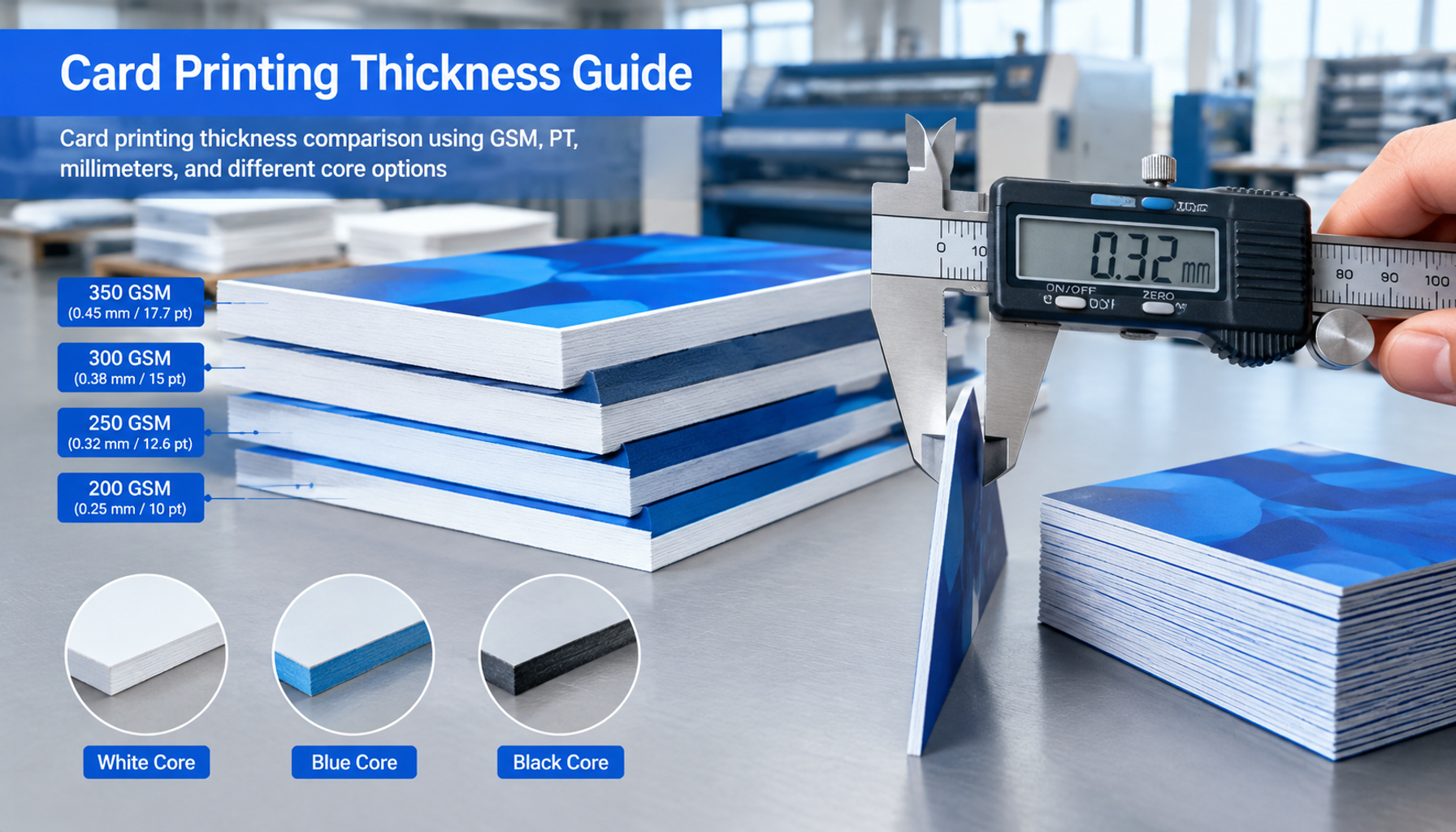
Card Printing Thickness: GSM, PT, and Core Selection Guide
A practical B2B guide to comparing GSM, PT, millimeters, paperboard cores, and plastic constructions when specifying custom cards.
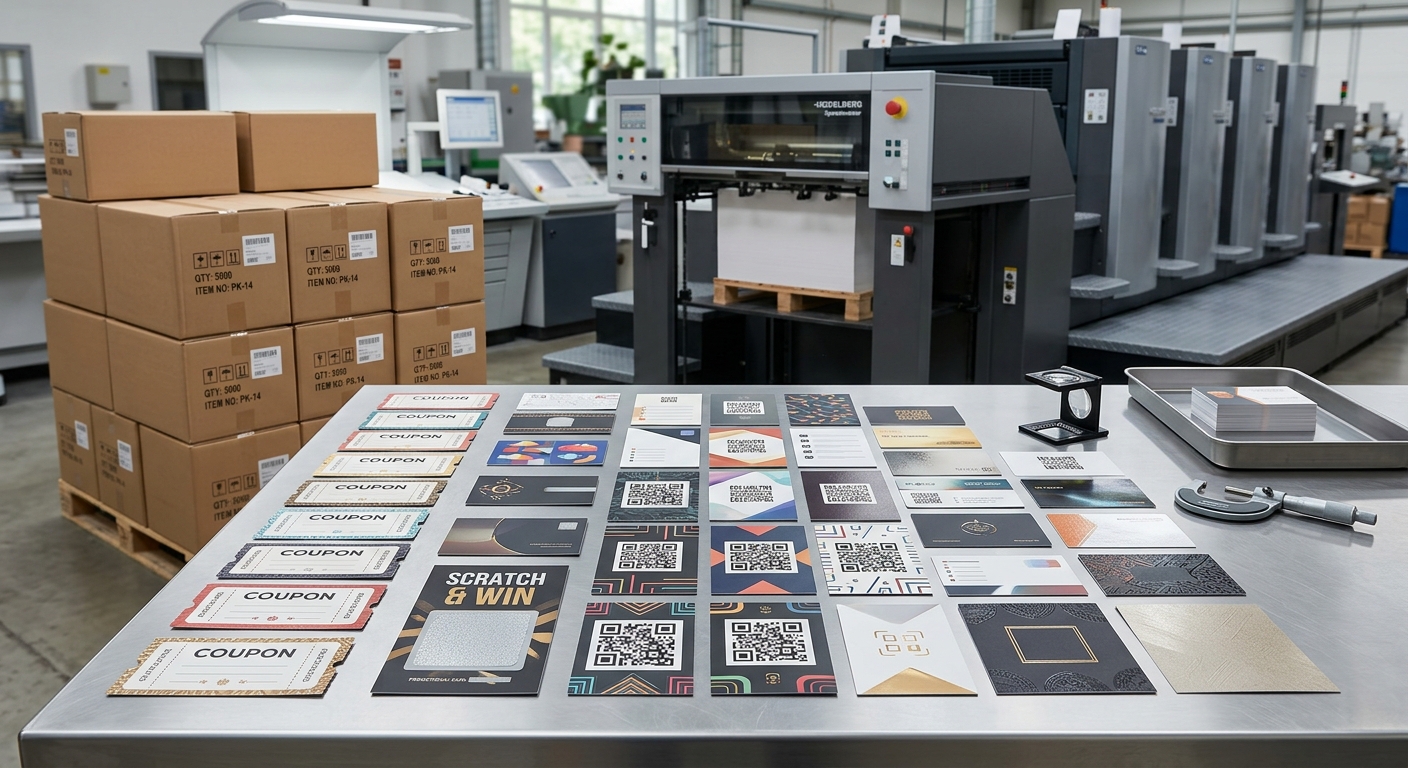
Custom Promotional Card Printing for Marketing Campaigns: Formats and Production Tips
Custom promotional card printing helps brands deliver compact, measurable marketing materials for launches, retail promotions, events, loyalty programs, and direct-mail campaigns. The best result depends on matching the card format, material, finish, artwork, quantity, and packaging to the campaign objective.

Custom Greeting Card Printing Wholesale: Sizes, Finishes, and Packaging Guide
Custom greeting card printing wholesale requires coordinated decisions about card size, paper stock, folding, finishes, envelopes, packaging, and shipping. This guide helps publishers, retailers, agencies, and gift brands prepare a practical production brief and reduce avoidable sampling or packing issues.
Fast Quote Support
Ready to Start Your Custom Card Project?
Send us your product type, size, material, quantity, and packaging requirements. Our team will reply within 24 hours with production suggestions, sampling options, and a competitive quote. No setup fees.